Services /
Modern workplace
Modern workplace.
Helping organisations redesign how work gets done — moving beyond AI as a productivity add-on to AI as a genuine part of how decisions are made, tasks are completed and value is created.
The challenge
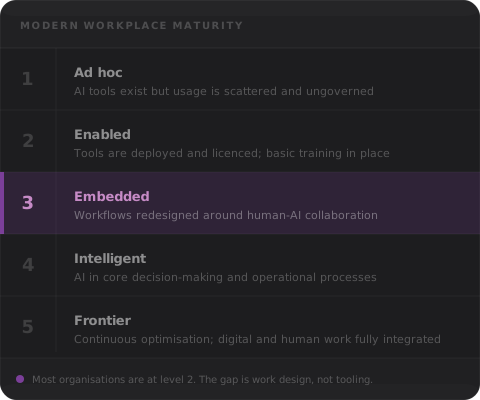
Most organisations have deployed AI tools. Fewer have redesigned work around them.
There is a growing body of evidence that a small group of organisations — sometimes called frontier firms — are pulling away from their peers. What distinguishes them is not which tools they have purchased, but how fundamentally they have changed the way work happens. They have moved from deploying AI on top of existing processes to redesigning those processes around human-AI collaboration.
The majority of organisations have done the first part well. They have invested in platforms, secured licences and run training programmes. What remains, though, is the harder work of redesigning processes, redefining roles and building the governance needed to sustain a genuinely different way of working.
Medasi helps organisations close that gap — not by advising on which tools to buy, but by working through the operating model, capability and change questions that determine whether AI investment actually changes anything.
2 in 3
senior leaders say AI tools have been deployed but working practices have not materially changed
18mo
typical lag between AI tool deployment and measurable adoption without deliberate work redesign
3x
productivity differential between organisations that redesign workflows versus those that simply add tools
Now
the only point at which strategy investment reliably pays back
What we assess
Six dimensions of a modern workplace.

Work design
Whether tasks and processes are structured around how humans and AI can most effectively collaborate, rather than legacy workflows with AI bolted on.
Are high-value processes mapped against AI capability?
Have human roles been redefined, not just supplemented?
Is process redesign treated as a first-class workstream?

Platform and tooling
Whether the AI capabilities in use are integrated into working practice — with appropriate data access, security controls and connections between tools.
Are tools integrated or operating in silos?
Do AI capabilities connect to the data they need?
Is shadow AI use being surfaced and managed?

Skills and capability
Whether people have the skills, confidence and structured support to work effectively and safely with AI tools in their daily roles.
Can people orchestrate AI agents, not just use AI features?
Is there a structured path from basic use to genuine proficiency?
Are skills gaps identified by role, not just by headcount?

Governance and guardrails
Whether AI use is managed through clear policies, accountability structures and controls — including what AI is permitted to do and on whose authority.
Is there a sanctioned AI use policy that people are actually aware of?
Are AI outputs subject to appropriate human review?
Is governance keeping pace with capability, not lagging behind it?

Culture and adoption
Whether the organisation has genuinely changed the way it works, or whether AI tools have been acquired but not adopted — a distinction that rarely shows up in licence data.
Is leadership visibly modelling the new ways of working?
Are resistors and champions identified and engaged?
Is change management a named workstream, not an afterthought?

Measurement and value
Whether the organisation is tracking the right things — outcomes and business value rather than tool usage rates and licence activation, which measure investment not impact.
Are benefit metrics defined in business terms, not technology terms?
Is there a baseline to measure against?
Does measurement drive decisions, or just report activity?
How we work
What you get
Concrete outputs that change how work happens.

Workplace baseline assessment
A scored, evidence-based view of the organisation's current position across all six modern workplace dimensions, with findings and prioritised gaps.

Work redesign roadmap
A sequenced programme of process and workflow redesign activity, prioritised by value, feasibility and organisational readiness, with clear ownership at each stage.

Human-AI workflow blueprints
Detailed workflow designs for priority processes, showing how human and AI roles interact, where decisions require human judgement and where automation is appropriate.

Capability and skills framework
A role-by-role view of the skills required for the new ways of working, mapped against current capability, with a structured development programme to close the gap.

Governance and AI use policy
A practical policy framework governing how AI is used across the organisation — including sanctioned use cases, accountability structures, data handling and review requirements.
Benefits and measurement model
A model that defines success in business terms — productivity, quality, speed, cost — with a baseline, target state and tracking cadence that holds the programme accountable for real outcomes.
Who this is for
Leaders who want AI investment to change how work happens.
Modern workplace engagements are most valuable when there is a recognised gap between AI investment and business impact — or when a significant workplace or operating model change is being planned and the organisation wants to design for AI collaboration from the outset, rather than retrofit it later.
Chief Operating Officer
Accountable for operational productivity and the efficiency case for AI investment
Chief People / HR Officer
Responsible for capability, workforce design and the employee experience of transformation
Chief Information / Technology Officer
Seeking to demonstrate that technology investment is translating into changed working practice
Transformation director
Leading a productivity or digital workplace programme and needing a structured delivery approach
When organisations engage us
AI investment not delivering returns
Tools are deployed and licences are active, but productivity gains are marginal or invisible. The organisation needs to understand why and what to do next.
Workplace technology investment planned
A significant platform investment or modernisation programme is under way, and the organisation wants to ensure the working model is redesigned alongside the technology.
Productivity programme under pressure
Efficiency targets have been set and AI has been identified as the mechanism — but the pathway from tooling to sustained productivity change is not yet clear.
Operating model redesign
A broader operating model change is under way and the organisation wants to design roles, processes and governance that reflect AI capability from the start.
Start the conversation
A practical conversation about where your organisation sits — and what it would take to close the gap.