
Services /
Process automation review
Find out which processes are worth automating.
Many mid-market organisations have processes that evolved through trial and error rather than deliberate design. Before automation is even relevant, we need to understand what those processes actually do — and whether they are ready for it.
The challenge
The automation question is asked too early.
Organisations under cost pressure or competitive threat reach for automation as an answer before they understand the question. They invest in platforms, hire specialists, and launch programmes — and then discover that the processes they intended to automate are too poorly defined, too data-dependent, or too politically contested to change.
The Process Automation Review addresses this directly. It evaluates which of your processes are actually worth automating, scores each one against six evidence-based dimensions, and produces a prioritised roadmap grounded in what exists today — not what you plan to fix before you start.
This is not a technology selection exercise. It does not recommend platforms or vendors. It produces a clear, defensible view of where automation investment will generate real returns, and where it will not.
Entry point 1
Technology-led organisations
You have AI ambition or capability but no structured view of which processes to focus on. You want process-level analysis without the full organisational scope of a readiness assessment.y
Entry point 2
Operationally-led organisations
Key processes are costing money, causing errors or holding back growth. The trigger is an operational problem, not a technology ambition. No prior AI assessment is needed.
Indicative scope
Candidate processes assessed
15 – 40
Processes reaching shortlist
5 – 12
First-wave recommendations
3 – 6
Engagement duration
4 – 8 weeks
The framework
Six dimensions. One defensible answer.
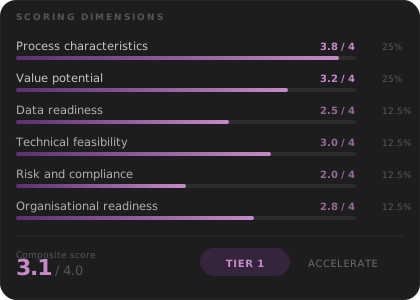
Each candidate process is evaluated across six dimensions. The first two are primary drivers. The remaining four act as feasibility qualifiers. A design quality check runs before scoring: processes that fail the threshold are flagged for redesign rather than scored for automation.

Process characteristics
How inherently automatable is the process, based on its volume, structure and the ratio of rule-based logic to human judgment?

Value potential
What is the realistic business benefit of automating this process, across cost reduction, error rate, cycle time and strategic impact?

Data readiness
Is the data the process depends on of sufficient quality, availability and structure to support reliable automation?

Technical feasibility
Can the current technology estate support automation without significant upstream change to underlying systems or integrations?

Risk and compliance
To what degree do regulatory, ethical or operational risks constrain the automation approach? A score of zero acts as a veto on shortlisting.

Organisational readiness
Does the organisation have the appetite and capability to adopt automation in this process area? Low scores affect sequencing, not fundamental viability.
How we work
A structured engagement that produces actionable clarity.
For the Process Automation Review, each stage has a defined focus: we discover the landscape, score and prioritise the opportunity, model the value, and hand over a recommendation pack that can go straight to the board.
1.
Discovery
Establish and validate the candidate process inventory through structured workshops with operational leads and process owners. Capture a Process Profile for each candidate — including design quality assessment — to confirm that each process is ready to be scored.
2.
Assessment
Apply the six-dimension suitability framework to each candidate process, combining structured interviews, operational data and technical review. Produce a composite score and tier classification for every process assessed. Apply the veto rule where risk and compliance constraints are prohibitive.
3.
Prioritisation
Model the realistic business benefit of each shortlisted process across cost, efficiency, quality and strategic impact. Sequence the shortlist into three delivery horizons — quick wins, near-term and transformational — accounting for feasibility constraints and organisational appetite.
4.
Handover
Deliver the full recommendation pack: executive summary, prioritised automation roadmap, individual business cases for first-wave processes and a risk register for constrained candidates. Presented to senior leadership with sufficient detail to support immediate programme initiation.
What you get
A roadmap you can actually use.
The final output is a prioritised automation roadmap with a clear first-wave recommendation, credible business cases for each shortlisted process and a rationale for every classification decision.
The roadmap is sequenced across three delivery horizons: quick wins achievable within six months, near-term initiatives within 18 months, and transformational opportunities beyond. Each recommendation comes with an indicative automation approach, key assumptions and the specific feasibility constraints that need to be resolved before delivery begins.
The recommendation pack is designed for the boardroom. Every number is supported by evidence. Every classification is defensible. The organisation leaves the engagement knowing what to do next, in which order and why.

Prioritised automation roadmap
Processes sequenced across three delivery horizons with first-wave recommendations and clear rationale.

Business case per shortlisted process
Indicative benefit ranges, key assumptions, realisation horizons and sensitivity analysis — defensible to the board.

Process profile per candidate
Structured evidence documentation for every process assessed, including design quality rating and score rationale.

Executive summary
A concise narrative suitable for board presentation, summarising the opportunity, the shortlist and the recommended first wave.
Who this is for
Leaders who need clarity before they commit.
All human beings are born free and equal in dignity and rights. They are endowed with reason and conscience and should act towards one another in a spirit of brotherhood.
Chief Operating Officer
Accountable for operational performance and the cost base; under pressure to do more without adding headcount
Chief Executive OfficerRole
Needs to make a credible case to the board for where automation investment will actually deliver
Chief Information or Technology Officer
Has technology appetite but needs a structured, business-led view of which processes to prioritise
Finance Director or CFO
Sponsoring a cost reduction programme; needs evidence-based business cases before approving capital
PE operating partner
Assessing automation opportunity as part of a value creation thesis in a portfolio company
When organisations engage us
Before a technology investment
The organisation is evaluating automation platforms or tooling and wants an evidence-based view of which processes justify the investment before a vendor is selected.
After a failed or stalled automation programme
A previous initiative did not deliver. The organisation wants an independent view of why, and a prioritised view of where to focus next.
Operational pressure with no clear starting point
Cost pressure, quality problems or growth constraints are rooted in process performance. The business knows something needs to change but does not know where to begin.
Following an AI readiness assessment
A prior readiness assessment has identified automation opportunities. This review takes those findings to the process level to produce a fundable business case.
Within a broader transformation programme
Process automation is one workstream in a larger programme. An independent review ensures it is grounded in evidence rather than internal advocacy.
Start here
Know which processes to automate before you commit.
Most automation programmes fail because they start with technology, not evidence. If this is a challenge your organisation is facing, I may be able to help.