
Services /
Programme recovery
Programme recovery.
Rapid diagnosis and stabilisation for programmes in distress — restoring credibility, control and momentum at pace, when there is no time to lose and no margin for further failure.
The challenge
Programmes in distress rarely fail suddenly.
Programme failure is almost always preceded by recognisable warning signs — signals that are present months before the situation becomes critical. The earlier a recovery engagement begins, the more options remain available.
An honest note
Programme recovery is difficult, costly and disruptive. The best outcome is one where it isn't needed — which is why every Medasi engagement begins with an honest assessment of whether prevention is still possible. If you are reading this page, act now. The window between "programme in difficulty" and "programme in crisis" closes faster than most organisations expect.
Nobody can clearly articulate what success looks like. The outcome definition has drifted and the team is executing against outputs, not outcomes.
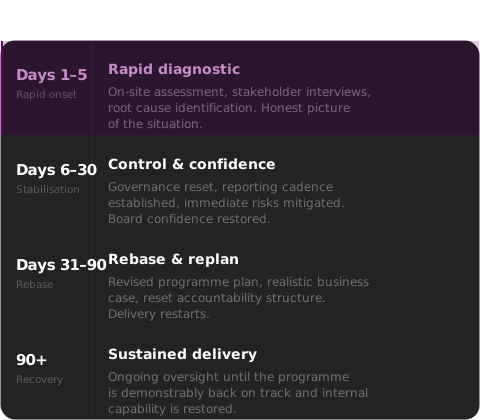
the 90-day approach
A structured, time-bounded approach to recovery. Built around restoring confidence first.
Days 1-5
Rapid diagnostic
An intensive, on-site assessment designed to establish an honest picture of the programme's current state — without the filter of optimism bias.
Structured stakeholder interviews at all levels
Document review: plans, RAID logs, financials, governance records
Root cause analysis of delivery failure
Rapid written assessment for board and executive sponsor
Days 6-30
Stabilisation
Immediate action to stop further deterioration, restore governance and give the board the confidence that the programme is back under control.
Governance and accountability reset
Reporting cadence redesign — honest by design
Immediate risk mitigation and dependency resolution
Stakeholder confidence management
Days 31-90+
Rebase & deliver
A realistic, credible programme replan — with a revised business case, clear accountability and a delivery cadence that can be sustained.
Programme replan with honest milestone sequencing
Business case refresh with stress-tested assumptions
Operating model and team structure review
Ongoing oversight through to stable delivery
What recovery looks like
The markers of a successfully recovered programme.
Who calls us
This is a familiar moment for a lot of good leaders.
Bringing in outside support for a struggling programme isn't a sign that something has gone unusually wrong. It's a normal part of running large scale change. The leaders we work with tend to be the ones who act on the warning signs rather than waiting for the situation to resolve itself.
CEO or MD
Accountable to the board for a programme that is losing credibility
Executive sponsor
Responsible for a programme where delivery confidence has broken down
Non-executive director
Seeking independent assessment of a programme the board is concerned about
PE operating partner
A portfolio company transformation that is threatening the investment thesis
Common questions
How quickly can you begin?
In most cases, we can begin the diagnostic phase within one week of engagement. Recovery situations are treated as priority engagements — we understand that time is a critical variable.
Will this be disruptive to the programme team?
The diagnostic phase involves structured interviews and document review. It is necessarily intensive, but designed to be as non-disruptive as possible. The stabilisation phase typically reduces disruption — it brings clarity and structure that teams in distress are usually relieved to have.
What if the programme can't be recovered?
We will tell you that, honestly, in the diagnostic phase. Not every programme should continue. Sometimes the most valuable outcome is a clear recommendation to close the programme in a controlled way and redirect the resources to something that can succeed.
How do you charge for recovery engagements?
Recovery engagements are typically structured as a diagnostic retainer, followed by a time-and-materials arrangement for the stabilisation and rebase phases. We will discuss the most appropriate structure at first contact.
Act now
A confidential conversation costs nothing. Waiting costs more than most organisations realise until it's too late.