
Services /
Operating model design
Operating
model
design.
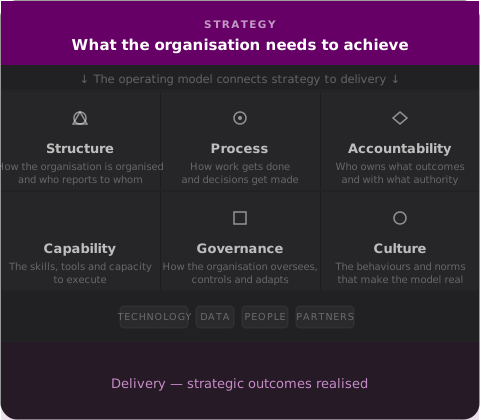
Redesigning the organisational structures, processes, accountabilities and governance needed to support and sustain strategic change so that strategy becomes something the organisation can actually do.
Why it matters
Strategy fails when the operating model is not designed to support it.
An operating model is the way an organisation actually works — its structures, processes, accountabilities and governance. Most strategies are designed in the absence of an honest reckoning with whether the operating model can deliver them.
The result is predictable. The strategy is sound in theory. The delivery is frustrating in practice. The gap between the two is almost always an operating model problem.
Medasi brings practitioner experience to operating model design — people who have led organisations through structural change and understand the difference between a model that looks right on paper and one that works under pressure.
Signs of operating model misalignment
1.
Decisions are slow or contested. Accountability is unclear and escalation is the default rather than the exception.
2.
Strategy and operations pull in different directions. What the organisation says it is doing and what it actually does are different things.
3.
Cross-functional work breaks down. Collaboration across organisational boundaries is consistently harder than it should be.
4.
New ways of working don't stick. Transformation initiatives produce change that is not sustained once the programme exits.
5.
Governance is theatre. Oversight bodies meet and produce papers but do not meaningfully change outcomes.
How we frame the conversation
Not this …
But this …
We need to. restructure
Decisions in your business take too long because nobody is clearly accountable for making them. That's an operating model problem, not an org chart problem.
Our operating model needs a refresh.
Two teams are doing the same work and neither knows it. That's the gap we close.
We'll redesign the organisation.
In 12 weeks, you'll have a target model with named accountabilities and a transition plan your teams can actually absorb.
What we assess
Six dimensions of an operating model that works.

Organisatonal structure
How the organisation is configured — reporting lines, spans of control, team design and the logic connecting structure to strategy.

Process design
How work flows through the organisation — the core processes that must operate reliably for strategy to be delivered.

Accountability framework
Clear decision rights, ownership of outcomes and the authority structures that enable the organisation to act decisively.

Capability design
The skills, roles and capacity the organisation needs — and a plan for how to acquire, develop or partner for what is missing.

Governance design
The oversight structures, decision forums and reporting cadences that keep the organisation aligned and on course.

Change management
The approach to taking people through operating model change — communication, engagement, training and sustained adoption.
the 12-week approach
Structure follows behaviour, not the other way round.
Operating model change fails most often when it is designed faster than an organisation can absorb it. Twelve weeks is long enough to build a model that will hold and short enough that it doesn't drift into permanent review.
Weeks 1-4
Understand how the organisation actually works
Current-state assessment complete, including informal structures and workarounds the org chart doesn't show
Signs of misalignment evidenced, not asserted: where decisions stall, where accountability is contested, where governance produces minutes but not outcomes
Design principles agreed with leadership before any target model options are drafted
What you get
A complete operating model design, ready to implement.

Current state assessment
An honest picture of how the organisation currently operates — structures, processes, accountabilities and the gaps between them.

Target operating model
A fully articulated target model across all six dimensions — structure, process, accountability, capability, governance and change.

RACI framework
Accountability mapped across the key decisions and processes — who is responsible, accountable, consulted and informed for each.
Board-level one-pager
A standalone summary of the case for change, the target model and the top risks of standing still

Transition roadmap
A phased implementation plan — sequencing the move from current to target model in a way the organisation can realistically absorb.

Maintenance regime
A phased implementation plan — sequencing the move from current to target model in a way the organisation can realistically absorb.
Who this is for
Leaders who know their organisation needs to work differently.
Operating model design engagements are most valuable when the organisation is facing a significant change in strategic direction, scale or context and when leadership recognises that the existing model was designed for a different set of requirements. They are also valuable in the aftermath of a period of rapid growth, where structure has not kept pace with scale.
Chief Executive Officer
Accountable for organisational performance and strategic delivery
Chief Operating Officer
Responsible for operational design and cross-functional performance
Chief People Officer
Leading organisational design and workforce capability
Transformation Director
Delivering a programme that requires operating model change to succeed
When organisations engage us
Strategic change
A new strategy requires the organisation to work in fundamentally different ways for which the existing model was not designed.
Post-growth redesign
Rapid growth has outpaced the operating model. Structure, process and governance need to catch up with scale.
Integration
A merger or acquisition requires two operating models to be rationalised into one, with clarity on what the combined organisation looks like.
Transformation enablement
A major transformation programme requires an operating model that can sustain the change once the programme exits.
Design for delivery
Build an operating model your strategy can actually run on.
A conversation about how your organisation is working today and what it needs to look like to deliver your strategy.