
Services /
Technology estate prioritisation
Technology estate prioritisation.
Bringing strategic rigour to your technology portfolio decisions — determining what to invest in, modernise, consolidate or sunset, with evidence and logic your board and CFO can stand behind.
The challenge
Most technology estates have grown faster than the strategy that should be governing them.
Technology investment decisions are often made incrementally — one system, one vendor, one business case at a time — without a coherent view of the overall portfolio. The result is an estate that has grown complex, expensive and misaligned with current strategic priorities.
Leaders know this is a problem but rarely have a structured basis for prioritising action. The default is to do everything or nothing — either an ambitious transformation programme that overwhelms the organisation, or continued tolerance of a costly, fragmented estate that constrains delivery.
Technology estate prioritisation provides the missing middle: a clear, evidence-based view of the portfolio that enables deliberate, sequenced investment decisions — what to accelerate, what to stabilise and what to exit.
How we frame the conversation
Not this …
But this …
We need to modernise our technology estate.
You're spending to maintain systems that don't move the business forward. We'll show you exactly which ones, and what to do instead.
Everything needs investment, but the budget won't stretch.
Some of your estate deserves investment, some needs a controlled exit and most things in between need leaving alone. We'll tell you which is which.
We'll do a technology audit.
In 60 days, every system in your estate will have a disposition, a cost and a named decision-maker who can act on it.
Our Framework
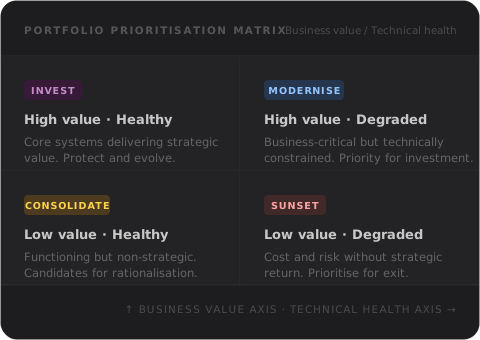
Four clear dispositions for every system in the portfolio.
Invest
High value, technically sound
Systems that deliver significant business value and are in good technical health. The priority is to protect, evolve and extend capability, not disrupt what is working.
Modernise
High value, technically constrained
Business-critical systems that are technically degraded, approaching end of life or limiting the organisation's ability to move. The priority investment case — high value, high urgency.
Consolidate
Low value, technically sound
Functioning systems with limited strategic relevance, often duplicating capability that exists elsewhere. Candidates for rationalisation, consolidation or replacement with commodity solutions.
Sunset
Low value, technically degraded
Systems generating cost, risk and maintenance burden without proportionate business return. The priority is a controlled, planned exit — before failure forces an uncontrolled one.
the 60-day approach
Evidence before disposition. Disposition before spend.
The 60-day horizon is the unit that matters. Mid-market technology estates rarely run to thousands of systems, so a multi-month enterprise-style review is the wrong tool for the job. We size the engagement to the estate, not the methodology to the engagement.
Days 1-20
Baseline
Estate inventory complete: systems, integrations, vendors, contracts and costs
Technical health rated for every system in scope
Business value criteria agreed with leadership before any system is scored
Days 21-40
Assess and place
Every system scored for value and technical health
Portfolio mapped against the invest, modernise, consolidate, sunset framework
Evidence pack built behind each disposition so the rationale can be interrogated, not just accepted
Days 41-60
Build the investment case
Sequenced investment roadmap drafted with costs and dependencies
Quick wins identified for systems where the disposition is obvious and the case for action is immediate
Board-ready output handed over, with the underlying evidence in client hands
What you get
A complete, investment-ready portfolio picture.

Technology estate inventory
A complete, structured baseline of the estate — systems, integrations, vendors, costs and technical health ratings.

Portfolio prioritisation matrix
Every system placed in the invest/modernise/consolidate/sunset framework with evidence-based rationale for each decision.

Cost and risk profile
The true total cost of ownership across the estate, including the cost of inaction on degraded or redundant systems.

Board-level one-pager
A standalone summary of estate health, the top risks of inaction and a clear recommendation, designed to be read independently of the supporting detail

Investment roadmap
A sequenced, phased investment plan with costs, dependencies and the business cases needed for funding approval.

Decision log
A record of every disposition decision, the evidence behind it and who signed it off, so the rationale survives staff turnover and budget cycles.
Who this is for
Leaders who need to make better technology investment decisions — and be able to justify them.
Technology estate prioritisation is most valuable when investment decisions need to be made — whether that is a budget cycle, a transformation programme, a change of ownership or a period of growth. It provides the evidence base that turns instinct into defensible investment strategy.
Chief Information / Technology Officer
Responsible for the technology estate and investment strategy
Chief Financial Officer
Accountable for technology spend and investment return
Chief Operating Officer
Reliant on technology estate to deliver operational performance
PE operating partner
Assessing technology estate as part of a value creation or exit strategy
When organisations engage us
Pre-transformation
Before initiating a major programme, to understand what the estate can and cannot support — and what needs to change first.
Budget cycle
Annual technology investment planning where the organisation needs a structured basis for allocation decisions.
Change of ownership
PE acquisition, merger or carve-out where a clear estate picture is needed for due diligence or integration planning.
Post-growth rationalisation
An estate that has grown through acquisition or rapid scaling and now needs to be rationalised and simplified.
Start here
Know exactly what your technology estate is worth — and what it's costing you.
A structured conversation about your estate and the investment decisions you're facing.