
Services /
Transformation strategy
Transformation strategy.
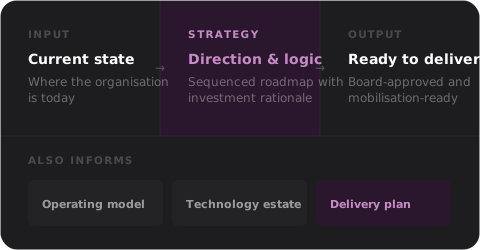
Defining the direction, sequencing and investment logic for complex change, from initial diagnostic to an investable strategic roadmap your board and delivery team can both work from.
The challenge
Most organisations have a strategy. Fewer have one that can be delivered.
Strategies fail not because they are poorly conceived, but because they are poorly translated. The journey from a board-approved direction to a mobilised programme is where most value is lost, in ambiguity, misalignment and the absence of a credible sequencing logic.
A transformation strategy that works has to do two things simultaneously. It has to be compelling enough for a board to fund it and specific enough for a delivery team to act on it. Those two requirements pull in opposite directions and bridging them is where the real work lies.
Medasi brings practitioner-level rigour to strategy development — the kind that comes from having sat on both sides of the table, and from understanding what makes programmes succeed or fail in practice rather than in theory.
How we frame the conversation
Not this …
But this …
We need a transformation strategy.
Your board has approved a direction but nobody can tell you what happens in month one. That's the gap we close.
We'll define your strategic priorities.
In eight weeks, you'll have a roadmap your delivery team can start work from on day one, not a deck that needs translating first.
The strategy just needs sign-off.
A strategy that only survives the boardroom isn't finished. We test it against what your organisation can actually deliver before it goes near the board.
the 90-day approach
Direction before detail.
Investment case before delivery.
Eight weeks is enough to move from diagnostic to an investable roadmap without the strategy work itself becoming the delay it's meant to prevent.
What you get
Tangible outputs at every stage.

Current-state assessment
A structured diagnostic of your organisation's strategic position, capability gaps and transformation readiness.

Strategic direction document
A clear articulation of transformation objectives, priorities and the logic connecting them to business outcomes.

Phased delivery roadmap
A sequenced programme plan with milestones, dependencies, resource requirements and decision gates at each phase.

Board-ready business case
A full investment case with benefits model, cost profile, risk register and governance framework — structured for approval.

Benefits realisation model
A realistic model of how and when the investment pays back — including the assumptions, dependencies and tracking approach.

Governance design
The accountability structure, decision rights and reporting cadence needed to keep the programme on track from initiation to delivery.
Who this is for
Built for leaders who need a strategy that holds up under delivery.
Transformation strategy engagements are typically most valuable at one of three moments: before a major programme is initiated, when an existing strategy has lost board confidence, or when a significant change in market or operating conditions requires a strategic reset.
Chief Executive Officer
Accountable for strategic outcomes and board confidence
Chief Operating Officer
Responsible for operational delivery and cross-functional alignment
Chief Information / Technology Officer
Leading technology strategy and estate investment decisions
Private equity operating partner
Overseeing value creation and transformation in portfolio companies
When organisations typically engage us
Pre-programme initiation
A major transformation is being scoped and the organisation wants a robust strategic foundation before committing to delivery.
Strategy reset
An existing programme has lost direction or board confidence and a credible strategic rebase is needed before delivery restarts.
Growth or transaction event
An acquisition, exit preparation or significant growth phase requires a refreshed technology and operating model strategy.
PE portfolio value creation
A PE-backed business needs a 100-day or full-hold transformation strategy aligned to the investment thesis.
Start the conversation
Ready to build a strategy that delivers?
Speak with an experienced transformation leader about your programme —
no obligations, no sales process.